
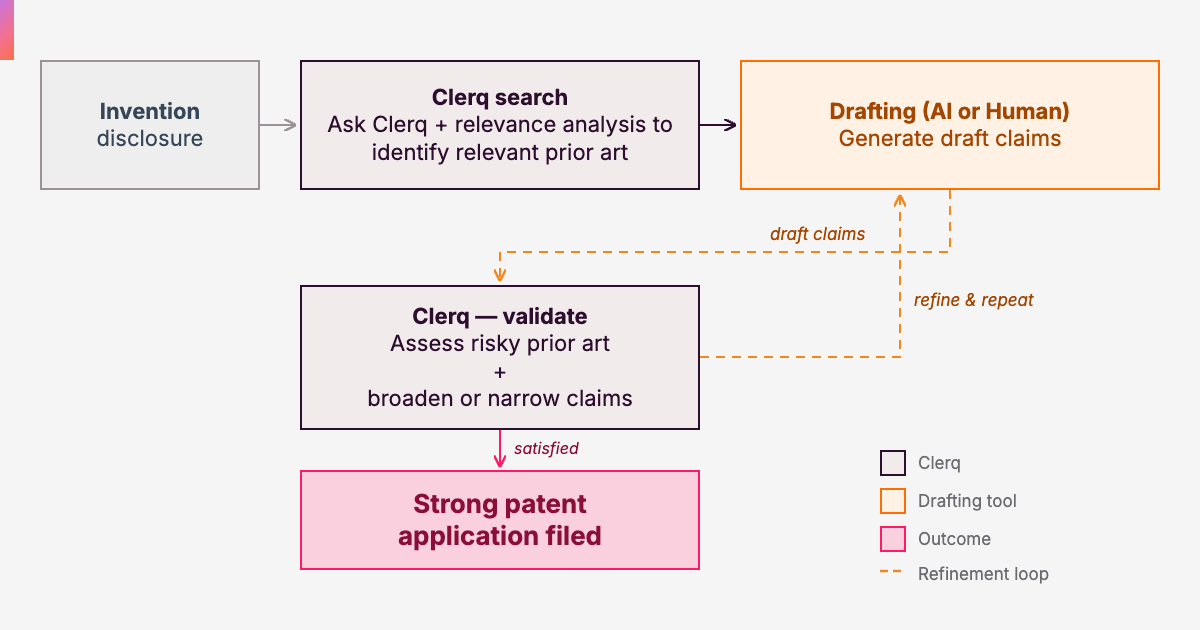
In a previous post, we wrote that "prior art search" is an important part of context gathering — the information foundation that everything downstream in the patent process depends on. That sets up the next question and the subject of this article. Once you have that context, how does the patent preparation process change when it's AI-enabled?
The traditional drafting process was linear, progressing from one step to the next. You took the invention disclosure, maybe ran a search (or waited on an outsourced one), and once the results came back, you drafted the application, starting with the claims. When the draft was good enough, it was submitted to the patent office for examination. Search was a discrete, sometimes optional, checkpoint near the front of the process—clear it, and move on.
The temptation with AI is to drop it into that same step-by-step process and expect a return. That mindset is where a lot of the disappointing AI pilots reported recently come from —the tools change, but the workflow doesn't. The highest return on AI tends to come from a lateral move — building workflows that weren't previously possible. For patent drafting, that plays out in two phases.
Phase 1: Invention capture and search
The starting point is largely the same whether or not AI is involved. You have a discussion with the inventor about the scope of protection and capture enough detail to begin work. From there, you would conduct a search.
As we covered in Part 1, prior art search is more than just a checkbox item. Especially if AI tools are used downstream in the process; the search is what gives them the context they need to work efficiently. Search does more than simply assess novelty; it surfaces the vocabulary used in the field, the technical framing that recurs across the area, and the claim language that has held up for similar inventions. The references that are pulled, and the analysis behind them, become invaluable input to everything that follows.
Adding AI-powered search also changes the economics. Compared to keyword tools, AI-native searches can cut search time by up to 90%, and for those who outsourced, the week or two of waiting disappears entirely.
The cost and time savings are indisputable, but the bigger win is what AI search tools unlock for patent professionals. Instead of being stuck with one query and whatever it returns, you can reframe the invention, chase a reference into a neighboring area, and narrow things down until the results reflect where the invention actually sits. As we said in Part 1, a tight, accurate read of the landscape beats a big pile of loosely relevant results.
Once the results are in, running an analysis over them does the work of separating what is genuinely on point from what is merely adjacent. That distinction is precisely the judgment a downstream AI tool can't make on its own, which is why doing it here where the context lies in front of you, pays off later.
It is worth being clear about what counts as context at this stage, and it’s not strictly limited to published prior art found in a search tool. The client's own portfolio, relevant technical standards, and non-published or internal documents can all serve as valuable context too. Since the portfolio usually belongs to the client rather than the attorney, it is easy to overlook — but it often holds the closest analogues to the invention being drafted, and including it in the analysis deliberately can be one of the more valuable inputs available.
Phase 2: Iterative claim drafting and refinement
A number of AI tools assist with the drafting itself. It helps to think of them as a distinct layer from search—search is the discovery and analysis layer, while drafting tools are the creation layer that turns a prepared prior art picture into a draft. The two are sequential, and they work best together.
As presented in Part 1, whether the drafting is done by a human or assisted by AI, you need the right context to write effectively—and the quality of what you feed in directly determines the quality of what comes out. In practice, "good context" is concrete. The relevant references from the search, the technical vocabulary the field actually uses, and the claim language from analogous inventions. Hand a drafting tool that material and the first pass comes back close to where you want it. Hand it a bare disclosure with no surrounding context and it produces something that looks like an application but is built in a vacuum — and you spend several rounds of prompting climbing back to where good context would have put you on the first try.
That context also tells you where the claims can go. Knowing what is already out there is what lets you identify the white space — the room left between the existing art and the invention — and scope the claims to occupy it rather than collide with it. This is the difference between drafting toward a target and drafting on a prayer.
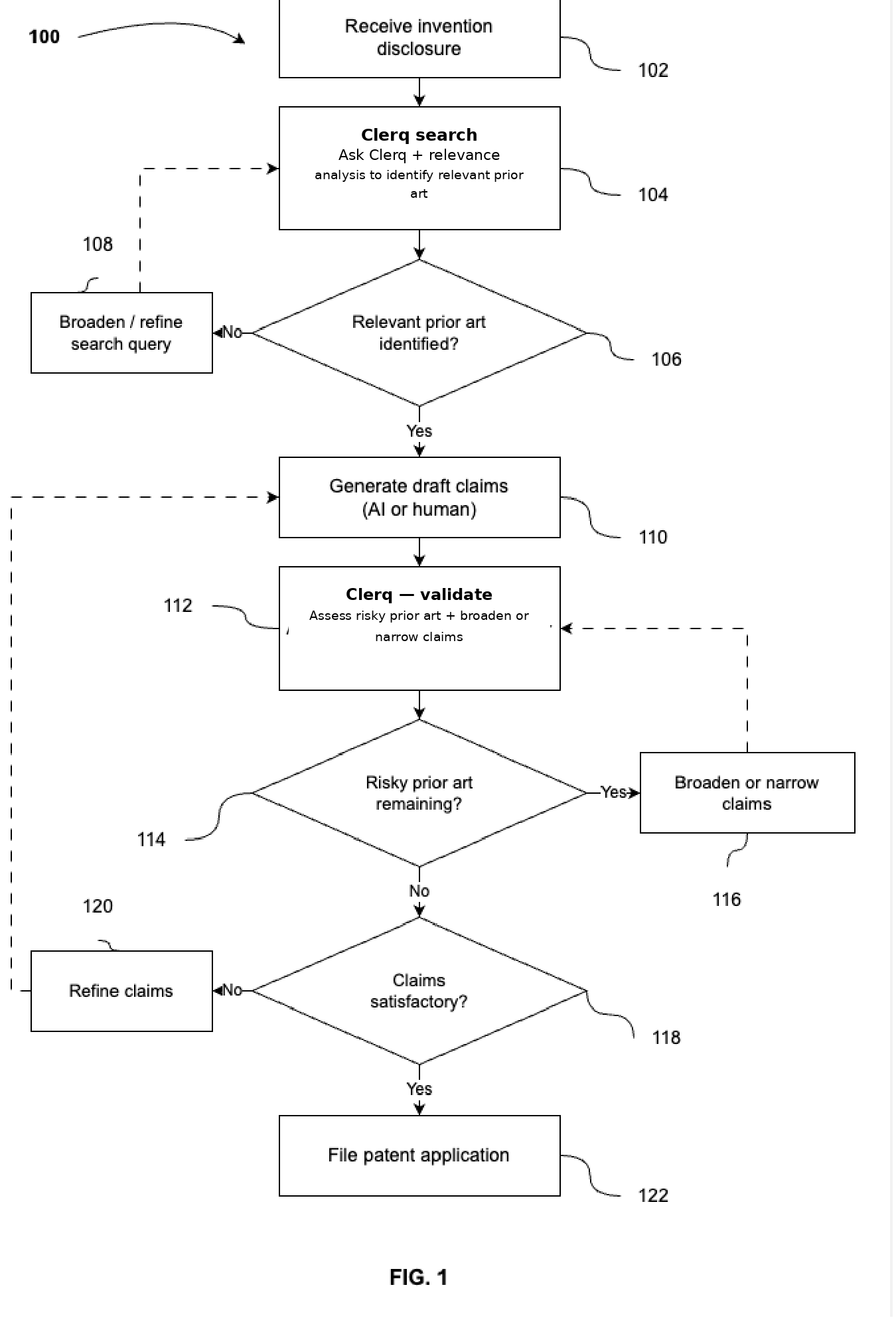
AI also unlocks a workflow that was previously impractical—claim proofing. Once a set of draft claims exists, patent professionals historically did not have an accurate / economical way to stress-test them. Today, attorneys can run those claims back through an AI tool as a fresh query. This serves two purposes: it flags any problematic prior art the claims may run into, and it informs how the claims should be scoped. A claim that reads cleanly on paper may sit closer to a known reference than expected, or may be broader than the art will comfortably support. Running a claim set back through an AI search tool is what makes that visible before an examiner finds it for you. Stress-testing draft claims against the landscape this way reduces risk later in prosecution — and it was something traditional tools simply couldn't support.
From there, the results tell you whether to broaden or narrow the scope of the claims. If a claim is bumping up against close art, narrow it; if the surrounding space is clearer than expected, you may have room to broaden. Adjust, re-test, and repeat. That real-time feedback loop — write, test, refine, test again — simply didn’t exist before. The closest historic equivalent was waiting for an office action to tell you what you could have known up front. It is what lets you arrive at a materially stronger application rather than discovering a problem after filing.
Why this matters
Everything discussed in this article becomes more consequential as national patent offices, like the USPTO, move forward with their own AI programs for examination. We can't predict exactly what each office will implement— but examiner-side AI tooling is coming. In a world where examiners search with the same power available to you, a weak search puts each submitted application at greater risk than it does today.
The stakes aren't limited to prosecution, either. A claim set that has been stress-tested against the surrounding landscape is also more defensible if it is later challenged. Applications that look solid on the way in are harder to unsettle on the way out, which makes this as much a litigation-exposure question as a prosecution one.
This is the way we expect drafting to take place going forward, and it is already how many of our clients work today. The conversation about AI is usually about efficiency; far less often is it about the new workflows that become possible, and this is a clear sample of one of them.
Book a demo and see Clerq in action.
Book a demo and see Clerq in action.