
What the Shoes Taught Me About Agentic Search
Patent search is constantly being reinvented. Here is what I have learned, and why I joined Clerq.
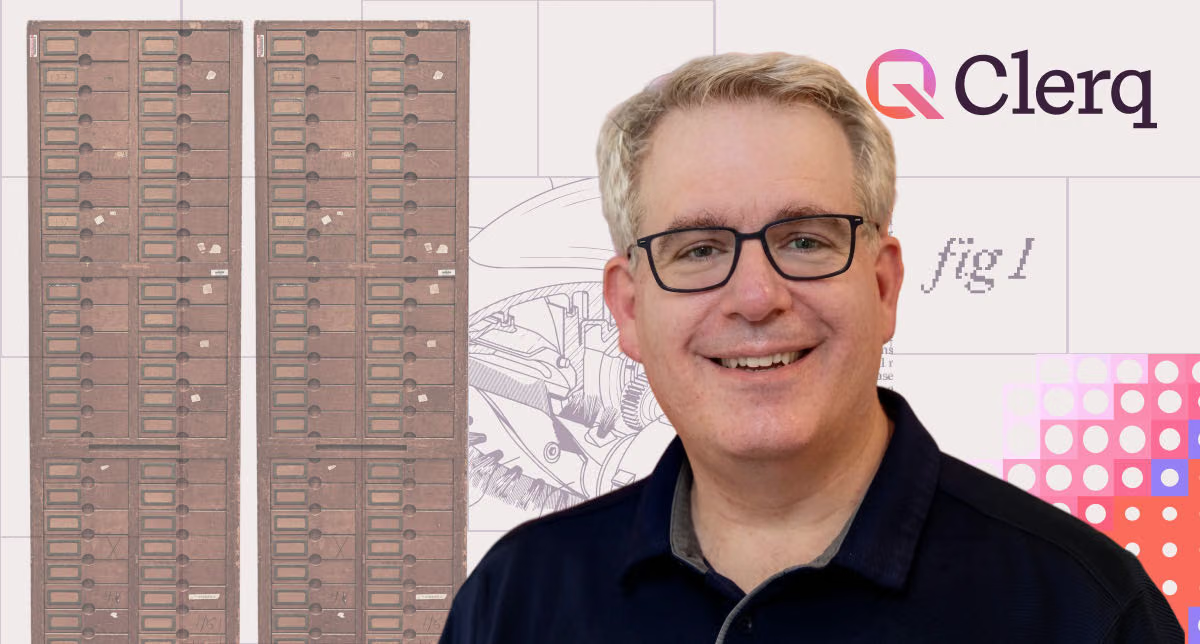
I started at the United States Patent and Trademark Office as a Patent Examiner in the summer of 1993, assigned to Art Unit 2608, Mobile Telephones. It was a good year to land there. Cellular was making its jump from analog to digital that year, and the applications crossing my desk were the industry arguing over how it should work. The tool of my new trade was a wall of file drawers.
We called them the shoes.
The name goes back to at least 1879, when the Office bought “shoe-drawers” from a Washington cabinet maker and started storing patents in them. They were ready-made furniture that happened to be exactly the right size for filing bundles of patents, and the name stuck for the next century. Every subclass of the US Patent Classification (USPC) system had its own shoe, and inside each one sat a stack of patents printed on light cardstock and stapled at the bottom.
That bottom staple was a small piece of genius. It held each patent together while letting the pages fan open, so you could work down a stack with your fingers and see what you had without pulling anything apart. Searching meant finding the right shoes and going through them, often standing right there at the drawer rather than carrying anything back to your desk. You could lose an afternoon on your feet in front of a wall of cabinets. Your search strategy was the classification schedule, and your search engine was your own two hands.
It sounds primitive now, but there was real craft in it. You had to understand how the classification system carved up all of human invention, and you had to know where the examiners before you had filed things that did not fit neatly anywhere. The best searchers were the ones who understood how inventions relate to one another, and that isn’t a skill you get from a keyboard.
The shoes were also only part of the system. The rest of it was us. You remembered a reference from a search you ran two years earlier. You kept a digest in your office, your own stash of favorite patents, the ones that taught a concept cleanly and came in handy again and again. And when you were stuck, you put your head into the hallway and asked whether anyone knew of a good reference that taught XYZ, and more often than not someone would pull out their digest and say “try this one.”
We were crowdsourcing before any of us had the word for it. Looking back, the whole floor was running a retrieval system: a set of privately curated collections, indexed by meaning rather than by classification, queried in plain language, and ranked by whose judgment you trusted.
Going through the shoes was the easy part to replace. Full-text databases did that within a few years. Replacing what happened in the examiner hallways took another thirty.
The Public Search Room
A few years later, I left the Office for a law firm while I was finishing law school, and I was occasionally sent back to the USPTO, this time to the public search room. What an interesting place! Rows of shoes, decades of yellowed patents, all stapled at the bottom, and an atmosphere that I can only describe as thick with history. I’m fairly certain I inhaled more dust mites in that room than any human should. If you ever wondered whether prior art has a smell, I can confirm that it does!
The professional searchers were there every day and they had their spots. A spot might be a table, or it might be nothing more than a chair parked by a particular section of the shoes. Nobody posted a sign about it. It didn’t take long for a newcomer to work out which ones were taken and find an unclaimed one for themselves.
Keywords and Boolean
The electronic era did not arrive all at once, and it did not arrive the way people assume. Even in 1993 we had the Automated Patent System, which let us search the full text of US patents back to 1971. I was writing Boolean queries as an examiner, and by the time I left, I could pull patent images up on screen and print them out. But the shoes were still where the real searching happened. The electronic tools supplemented the shoes, they didn’t replace them, and that gap between a tool existing and a tool being good enough to change the work is something I’ve now watched play out again and again.
The balance tipped over the following years. Examiners eventually moved to EAST and WEST, the search clients built on the BRS text databases, and Boolean became the whole language of the trade: keywords strung together with ANDs, ORs, and proximity operators, each platform with its own syntax and quirks. The paper collections were pulled from the examiners’ search rooms altogether, and the classification system I learned on gave way to the Cooperative Patent Classification (CPC) in 2013.
It was a genuine leap. You could search decades of full text in seconds, combine classification with keywords, and rework a strategy on the fly. But keyword searching introduced a new problem that every searcher knows intimately: inventors and patent attorneys are endlessly creative with language. A “fastener” in one patent is a “securing member” in another and an “attachment element” in a third. The searcher’s craft shifted from knowing the classification schedule to anticipating every way a drafter might describe the same idea. Recall became a game of synonyms, and the cost of missing one could be an invalidity problem years later.
Classification never went away, and good searchers never abandoned it. The strongest strategies combined both: classification to define the field, keywords to cut through it.
From In-House to Building a Team
From there the path ran through a patent firm and then in-house, where I spent over a decade at Accenture and led the patent group in my last two years. That is where I came to understand the value of a quality search as an input to real decisions: how to allocate limited resources, and where to protect and where not to. After Accenture came a stint as Chief IP Officer at a public-markets investment bank, and then Murgitroyd, where I led the Strategic IP Solutions group. One of the most satisfying things I did there was train a team of engineers to search patents, and I started them exactly where I started: classification codes and keywords.
That was deliberate. Tools change, but the fundamentals don’t. A searcher who understands how inventions are organized, and why the same concept hides behind different vocabulary, will outperform someone who only knows how to drive the platform. The shoes taught me that. I wanted my team to learn it too, even if they would never smell the dust.
Semantic Search, Then Generative AI
Over the last dozen years, the technology has evolved by leaps and bounds. Semantic search was the first big shift. Instead of matching literal keywords, these systems learned to match meaning, so a query about a “securing member” could surface the fastener patents anyway. It was the hallway question, finally asked of a machine. Paste in a paragraph, or an entire claim set, and the engine finds conceptually similar documents. The synonym game that consumed so much of a searcher’s energy started to fade.
Worth a footnote: EAST and WEST, the systems that eventually displaced the shoes, have since been displaced themselves. Examiners moved to PE2E-Search, and the public versions were retired in the fall of 2022.
Then came generative models, and the pace changed again. Retrieval did not go away; it got a layer on top of it that could read. Modern tools summarize a reference, map it against claim elements, explain why it is or is not relevant, and draft the first pass of a search report. Work that took a skilled searcher days now takes a fraction of that, and the searcher’s role is shifting from finding documents to judging them.
Agentic AI, Now
I said earlier that a tool existing and a tool being good enough to change the work are two different things. Agentic search crossed that line while a lot of the profession was still deciding what to make of it. These systems don’t wait for a query. Given an invention disclosure, an agent plans its own search strategy, runs it, evaluates what comes back, notices the gaps, reformulates, and iterates, at machine speed and without getting tired at four in the afternoon.
Every searcher I know uses more than one method, whether that is classification, keyword strings, citation chaining, or semantic queries. But you run them serially, and each one costs hours you then don’t have for the next, so the last approaches on your list get the least attention or never get run at all. The part that matters most is that an agent doesn’t have to work through them one at a time. It runs them in parallel, down different classification paths and different framings of the same concept, then selects the best of the combined results. That’s the examiner hallway again, except you are asking everyone at the same time and you don’t have to hope the right person is in today, or in a charitable mood.
I don’t think this makes the human searcher obsolete. I think it makes judgment the entire job. The agent can run the field far more thoroughly than I ever could standing at the shoes. What it hands back still has to be read against a business decision: whether a close reference is a real concern or a distinction worth arguing, whether the result changes a filing strategy, and what to tell the people who have to act on it. That’s where the experience matters, and it’s a better use of a searcher than flipping pages ever was.
Why I Joined Clerq
That is the work I want to be doing, and it’s why I am now at Clerq, formerly NLPatent, as Director of IP Strategy. The honest version of the story is that I was a customer first.
When I was first evaluating Clerq’s agentic search, I ran it against my own work. I did the searches myself first, the way I would have run them for a client: classification and keyword strings to define the field, semantic queries to catch the language I hadn’t thought of, and a generative tool to help me work through what came back. Then I handed the same searches to the agent and put the two next to each other. What took me days came back in minutes, and it found what I found and more. Thirty years of doing it the long way is a good reason to be skeptical, and running it against my own work was the only test I trusted.
The days I spent on those searches myself weren’t wasted, but most of that time went into the mechanical middle of the job rather than into reading, comparing, and deciding what any of it meant. Clerq took the middle. What was left was the part that actually needed me. Back when I was in-house, this is exactly what I wished existed and it didn’t. Now Clerq has built it, with scientists, engineers, and IP professionals who have done this work themselves. That last part matters more than people outside the field might guess. Search is an art as much as a science, and context is most of the art. Knowing how a search report will be read, relied on, and argued over is every bit as important as knowing how to build the tool that produces it. The model underneath it was trained on patent language rather than adapted to it. Clever patent drafters describe the same thing a dozen different ways, and a model that learned on ordinary text has no particular reason to know that a “securing member” and a “fastener” are the same idea.
There’s a version of this that matters more to the people who buy searches than to the people who run them. When I was in-house, cost and turnaround quietly shaped which questions I was willing to ask. A full search took long enough and cost enough that you saved it for the decisions that clearly justified it, and the smaller questions, the early ones, the ones where an answer would have changed direction before anyone was committed, often went unasked. When the cost of asking drops, you ask earlier and you ask more often. That’s a different way of running a portfolio, not just a cheaper way of running a search.
My focus is agentic search, working alongside the team and with customers. After three decades of watching this discipline get rebuilt from the outside, I would rather spend the next stretch of my career helping shape it.
One Constant
From flipping cardstock in the shoes, to breathing the dust of the public search room, to Boolean strings, semantic engines, and now AI agents, the technology of patent searching has been reinvented at least four times in my career. Through all of it the question stayed the same: has someone done this before, and what does that mean for what you want to do next?
I started answering that question at the shoes in 1993. I am answering it with agents now. I would not trade the dust for anything.
Book a demo and see Clerq in action.



Book a demo and see Clerq in action.